
Twin Falls Directory Runs
Twin Falls historical-directory research begins with several complementary collections. The Twin Falls Public Library Idaho Room identifies Polk's volumes as a local resource, but its public page does not publish a complete year list. Exact runs are easier to plan through the University of Idaho and Idaho State Historical Society inventories. The first verified city-and-county volume is 1908–09. Later telephone and business books extend the trail into 2005, though not for every year.
| Collection | Years | Where Held | Access |
|---|---|---|---|
| City and county directories | 1908–09 through 1932–33, selected runs | Idaho State Historical Society, reels 27–29 | Repository research |
| Later city and regional runs | 1950–1991, selected years | Idaho State Historical Society | Holdings list and archive access |
| Telephone directories | 1947–2005, with gaps | University of Idaho Special Collections | Year inventory and collection access |
| Business directories | 1955–1988, selected years | University of Idaho Special Collections | Collection access |
| Criss-cross directory | 1970 | Library of Congress guide | Confirm volume availability |
The gaps matter. An absent listing may reflect a missing volume, a move, an unlisted phone, a spelling variant, or a change in the way a regional book was filed. Nearby Buhl, Kimberly, and Hansen entries may simply say “See Twin Falls.” Check the regional heading before deciding a person vanished. The most recent University holding identified in the research is 2005, not a current resident roll.
Twin Falls Idaho Room Research
The Idaho Room is the best local starting point when the year or source is uncertain. Its roughly 25,000 rare or out-of-print books, pamphlets, oral histories, and audiovisual items cover Twin Falls, the Magic Valley, Idaho, and nearby states. Local newspapers begin in 1904 on microfilm. Staff also point researchers toward photographs, oral histories, old directories, and house or address material that may never have been indexed by name online.
A narrow request works best: give a surname or street address, an approximate year, and ask staff to check both the alphabetical and reverse sections when available. The library states a $5 per-item research fee. That charge applies to its reference research service, not automatically to every page or copy in every collection.
The library's local-history page shows the research routes and collection scope. Its captured view gives a useful preview of the Twin Falls local-history desk:
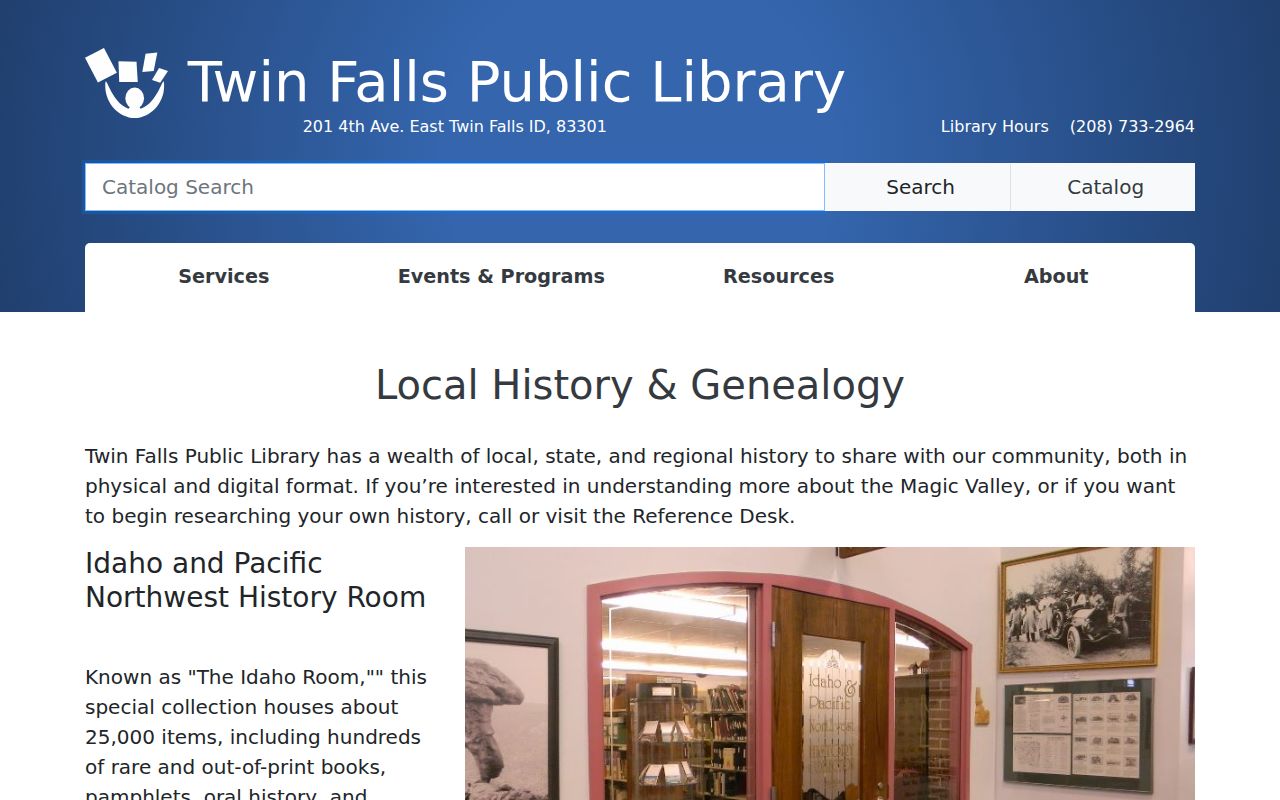
The image confirms that directory work here belongs to a broader local-history collection, where a name can be checked against newspapers, images, and regional records.
Twin Falls Directories Since 1908
The Idaho State Historical Society holdings list begins with Twin Falls City and County for 1908–09 on reel 27. That reel also carries 1910, multi-county 1914–15, and Twin Falls County 1916–17 material. Reel 28 holds 1918–19 and 1920–21 runs. Reel 29 continues with 1923–24, 1925–26, 1928–29, 1930–31, and 1932–33. Multi-county books require searching the city heading and the county section.
| 1904–05 | Original plat, local newspapers, irrigation, railroad, and early municipal records form the first address trail. |
|---|---|
| 1908–33 | Repeated state archive reels provide the earliest verified directory sequence. |
| 1947–2005 | Selected university telephone runs extend household and phone evidence into the postwar era. |
Twin Falls County was created in 1907 from Cassia County. A pre-1907 search may therefore need Cassia-related sources as well as later Twin Falls collections. No courthouse disaster or mass record loss was verified, so gaps should not be explained by a fire or flood.
Decode Twin Falls Directory Entries
Copy the full line before interpreting it. A Twin Falls historical entry may include a head of household, spouse or relationship notation, occupation, employer, residence, telephone, widow notation, and an ownership or occupancy mark. Fields differ by publisher and year. The key printed in that specific volume controls the meaning, so a familiar-looking letter should never be expanded from memory.
| Name | Surname and given name or initials; a spouse may appear in parentheses. |
|---|---|
| Work line | A historical occupation or employer as printed in that year's book. |
| Address | House number and street, sometimes with a residence or boarding mark. |
| Household marks | Owner, renter, widow, spouse, or telephone details when the publisher included them. |
| Citation | Volume year, publisher, page, heading, and exact spelling. |
- Criss-cross directory
- A reverse arrangement that lists addresses in street order, then gives the occupant or subscriber shown for that year.
- Householder index
- A list centered on household names rather than every person who may have lived at the address.
- Abbreviation key
- The publisher's legend for shortened words and symbols. Save it with every transcription.
Twin Falls Address Clues
The NPS Original Townsite Residential Historic District nomination preserves concrete directory examples. Its 1916 material places Morgan Heap at 312 Seventh Avenue North and Harvey Tessier at 344 Seventh Avenue North. The same nomination cites 20 boarding houses in a 1910 directory and a census household at 443 Second Avenue North. Those examples show why an owner-only search misses much of the early city.
Boarders and occupants can appear in a historical book even when they held no deed. A modern parcel owner field answers a different question. Record the person, address, year, and source together, then seek a census, newspaper, deed, or cemetery match before linking the entry to a family.
Twin Falls Telephone Directory Years
The University of Idaho Special Collections inventory gives the clearest postwar year map. Telephone books are listed for 1947, 1949, 1952, 1954, 1956–59, 1961, 1963–65, 1967–71, 1974–77, 1979, a long sequence through the 1980s and early 1990s, selected mid-1990s years, 1997, 1999–2003, and 2005. Business directories cover selected years from 1955 through 1988.
The inventory itself is worth checking before travel or a reference request:
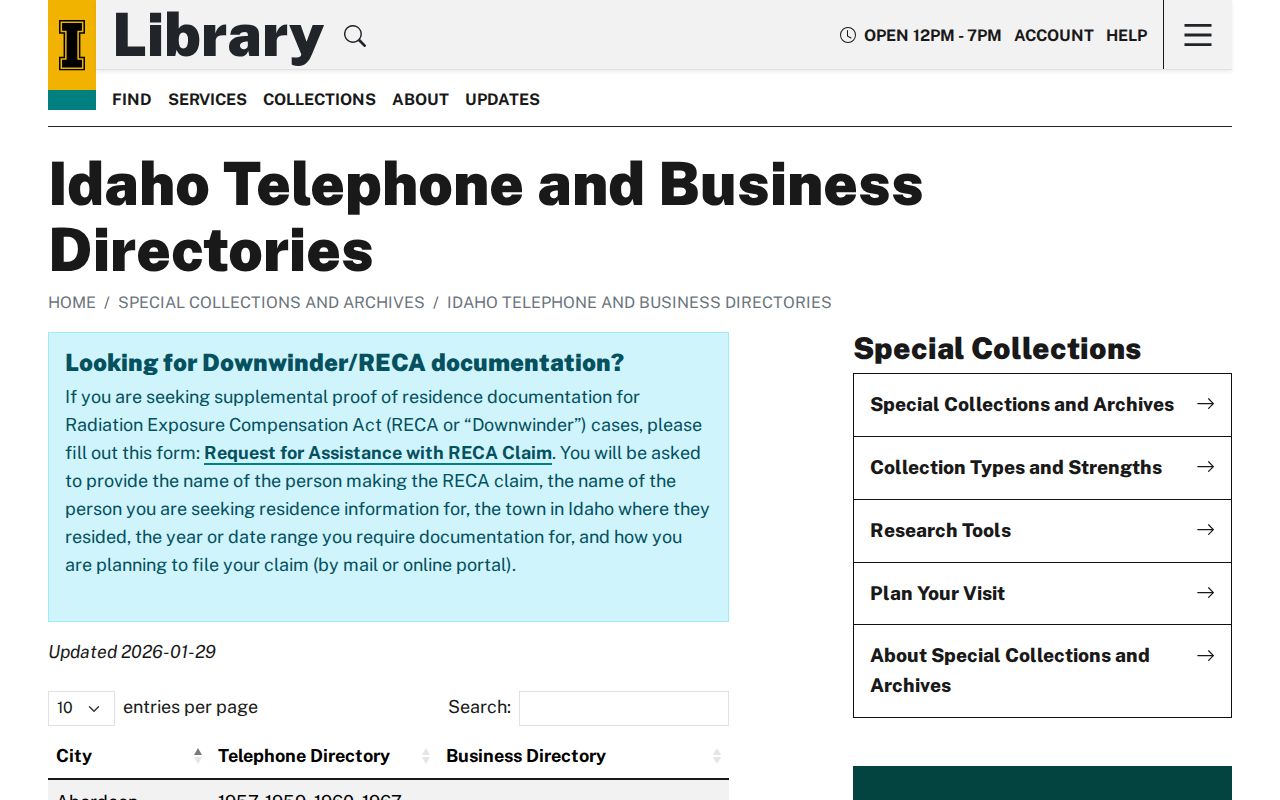
The screenshot makes the gaps visible. Search the nearest volumes on both sides of a target date, but never assume a person stayed put during the missing interval.
Twin Falls Directories Meet Newspapers
A directory gives a compact line; a newspaper may explain it. Chronicling America carries The Twin Falls Times for 1905–1916, with digitized issues from 1908 through 1916, plus a related title into 1918. Search the exact surname, street phrase, business name, and spouse. Obituaries, public notices, club items, and legal advertisements may place that directory entry in context.
For years outside the digitized run, the Idaho Room's newspaper microfilm reaches back to 1904. If a surname is common, combine it with a middle initial, spouse, known street, or nearby business. Keep newspaper dates with the clipping because directory editions may have been compiled months before their cover year.
Note: Older print and handwritten indexes may contain spelling errors, so inspect the original image and test initials, phonetic variants, and nearby headings.
Twin Falls 1970 Reverse Directory
The Library of Congress address-directory guide identifies a 1970 Twin Falls criss-cross volume. Unlike the usual surname arrangement, this format lets a researcher start from an old street address and move toward the listed occupant or phone subscriber. It is especially useful for a photograph, postcard, family letter, or deed that supplies an address but no reliable name.
Reverse order does not make the book a complete population list. Unlisted phones, apartments, boarders, vacant property, and publication lag can all leave gaps. For modern address-keyed work, use the Twin Falls street directory process and official parcel tools rather than treating the 1970 volume as current.
Trace Twin Falls Family Lines
A Twin Falls printed volume works best as one dated link in a longer family trail. Start with the closest known year, transcribe the whole entry, and then move one available volume at a time. Census schedules, newspapers, deeds, probate indexes, and cemetery records can resolve a move or death that the directory alone cannot explain.
- Find the closest available volume and cite its year, publisher, page, spelling, and abbreviation key.
- Check the next earlier and later available runs. Note each address, spouse notation, and change in initials.
- Use a reverse section when available to inspect the address and nearby listings.
- Pair the sequence with released federal census years. The federal public-release rule is 72 years.
- Test a disappearance against newspapers, cemetery sources, probate indexes, and the deed trail.
The Idaho State Historical Society indexes add biographical, naturalization, reconstructed census, and pension leads, but coverage is selected and incomplete. FamilySearch's Twin Falls County collection adds probate, death, marriage, and deed material for historical periods. Confirm cemetery leads with the cemetery office or official memorial source. Community entries are clues, not legal proof.
Bridge Twin Falls Directory Gaps
No surviving inventory supplies every year. The sound response is to date each source, not fill the blank with a guess. A directory address, parcel situs, legal description, and mailing address are separate facts. Historic city boundaries also changed, while early local material may sit under county or multi-county headings.
Use the nearest books, then compare a released census, a dated newspaper notice, and the historical deed or probate collection. Search initials and alternate spellings. If the question concerns a current name or official copy, move from the historical shelf to the proper custodian. A modern Twin Falls resident lookup should verify identity in current official sources without converting an old directory line into a present fact.